
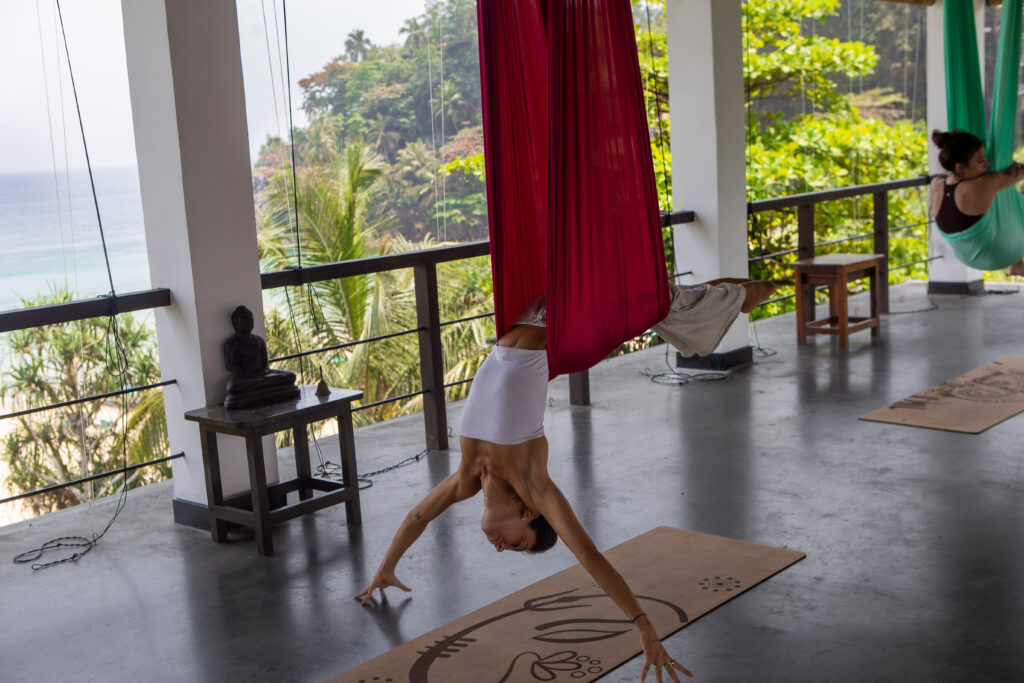
That is how Melanie, our aerial yoga teacher, describes what she watches happen each class. Over 21 years at Talalla, we found that decompression matters more than tricks, which is why aerial sits inside the daily timetable, not as a novelty. Hanging upside down at Talalla, you can hear the ocean. You can also hear birds, and most days, the peacocks. The shala is open on every side, with a near 360-degree view over the south coast and a steady breeze off the water. Most people arrive expecting tricks. What they leave with is something quieter. We ran our first yoga classes here 21 years ago. Aerial is a newer addition to that programme, and one that earned its place fast.As a teacher, I love to witness the sense of empowerment students feel when taken upside down and far out of their comfort zone.
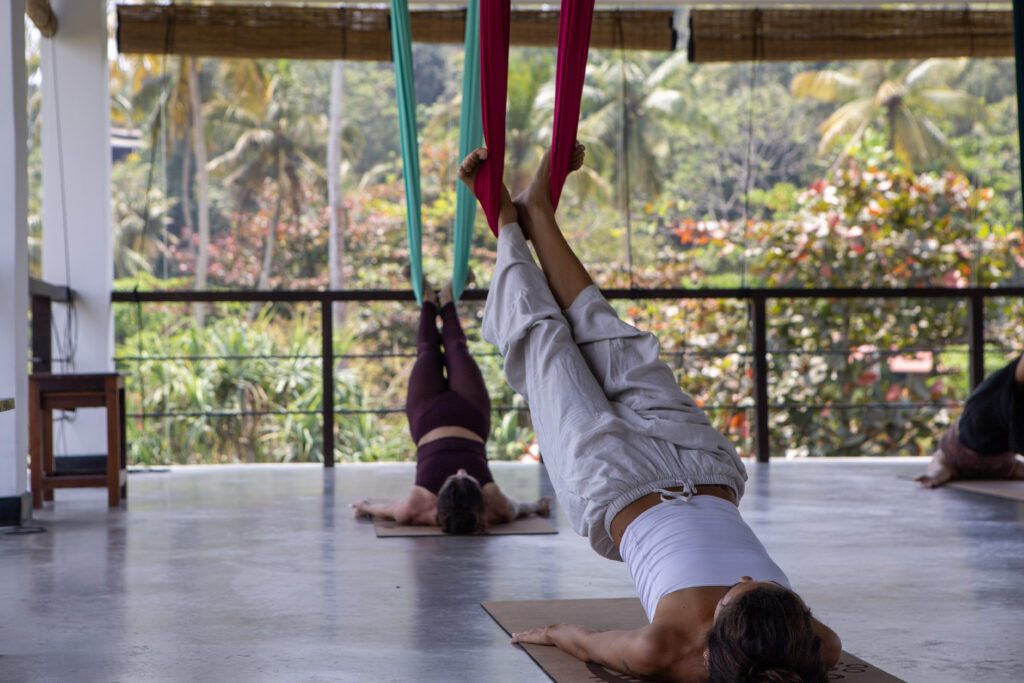
After we added aerial, we found two groups walk in cramped
Most people who land in Sri Lanka have spent the last week gripping something. A handlebar, an armrest, a phone. Their shoulders sit up near their ears before they unpack.
Watching class after class, we found the same two groups arrive in this state: surfers carrying tight shoulders from long sessions, and travellers cramped from long flights or train journeys of 10 hours or more.
Aerial is the antidote for both. After the first 20 minutes of hanging upside down in a soft fabric hammock, the focus quietly shifts. The hammock takes load off the spine, opens the chest and shoulders, and lets the nervous system reset in a way downward dog doesn’t quite reach.
It isn’t about tricks. It is about decompression. That distinction shapes the whole way we teach it.
For our yoga programme, aerial sits as the piece between strong mat practice and the slow recovery work in the bathhouse. It does the thing that needs to happen first, before anything else can really land.
The setting really does change the practice
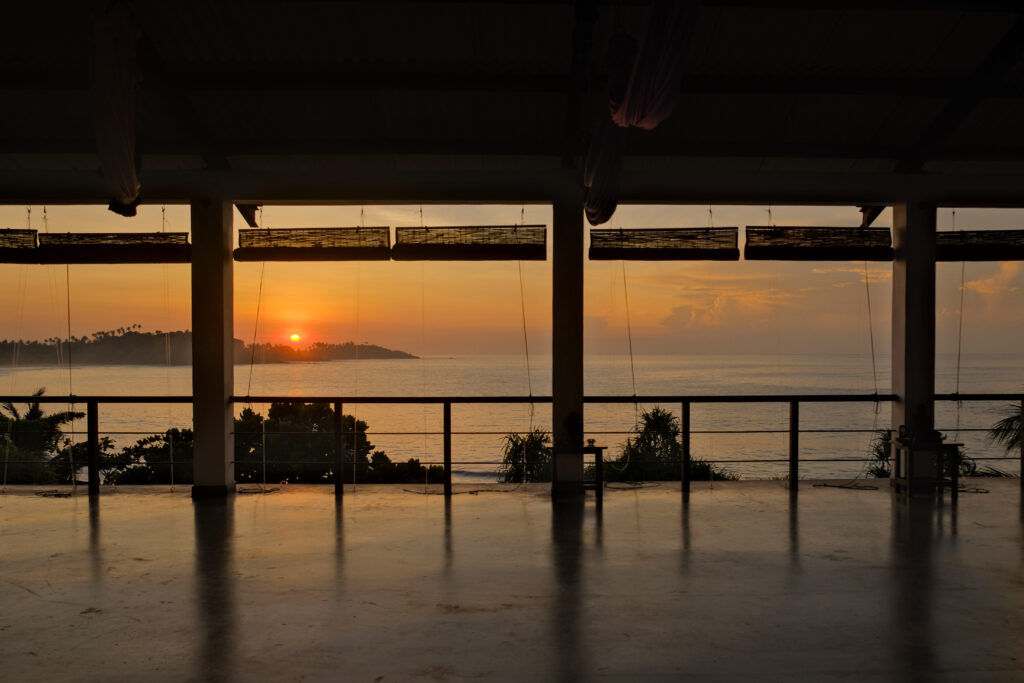
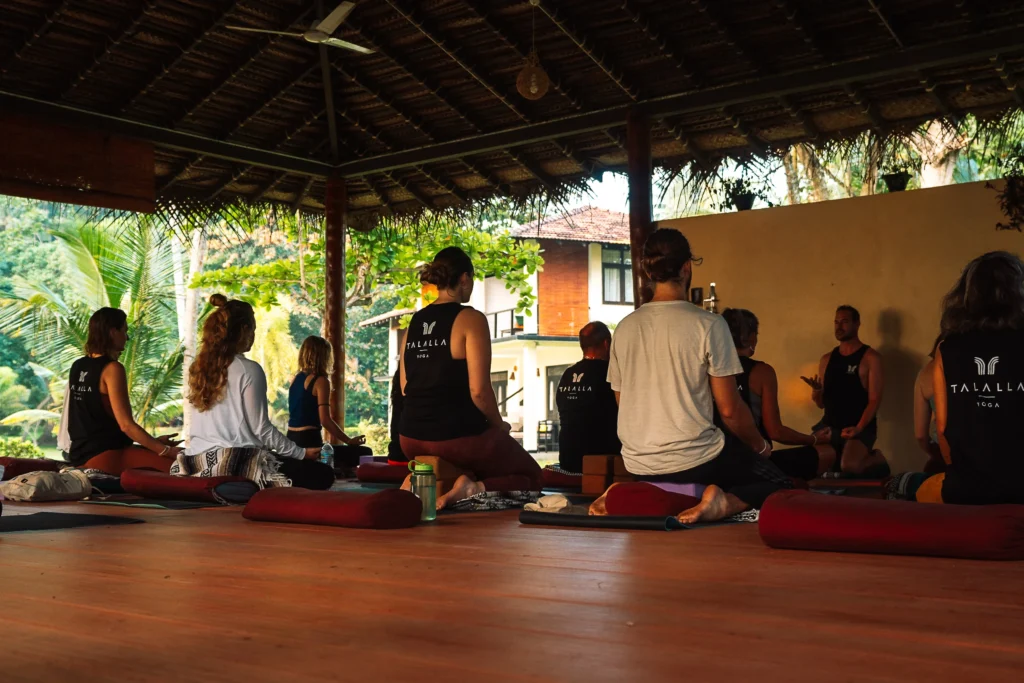
We are not the first retreat in Sri Lanka to add aerial. We are one of the few practising it in a fully open-air shala with a near 360-degree view of the coast.
When you’re upside down, your nervous system reads the environment first. Walls and air conditioning send one signal. Ocean breeze, birdsong, and the sound of waves a few hundred metres away send a different one.
In our shala, the second signal does the heavy lifting. The breath slows. The grip softens. The mind has somewhere to go that isn’t the ceiling.
That is the part our regular guests mention most often. Not the postures. The setting.
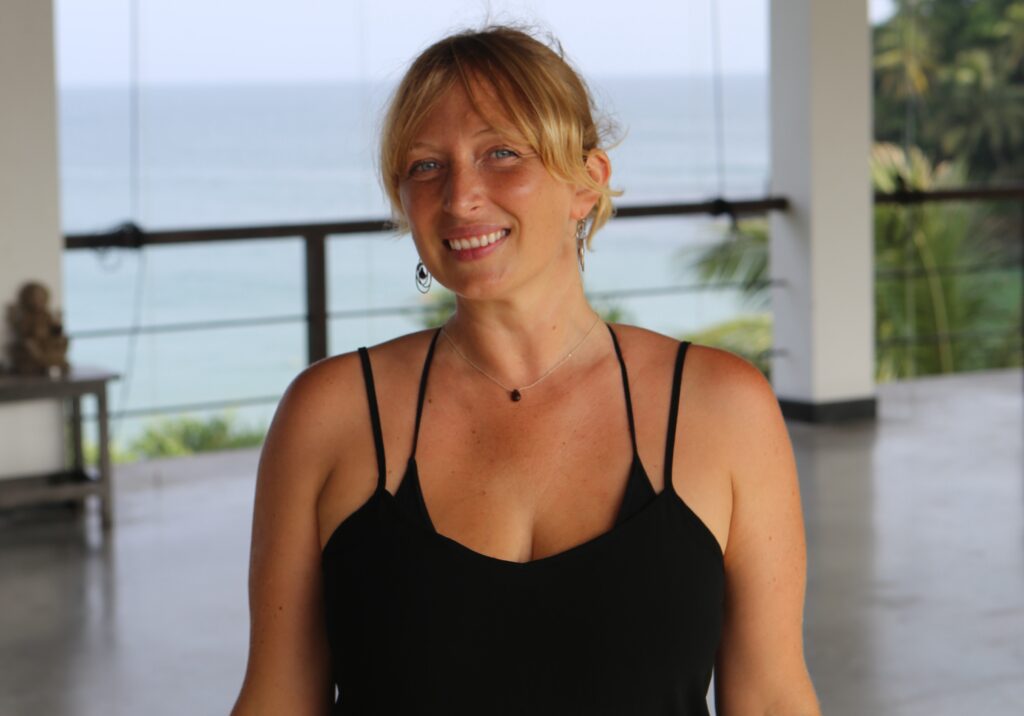
Empowerment, in Melanie’s words
When we asked Melanie what she watches happen during class, this is what she sent us first:
As a teacher, I love to witness the sense of empowerment students feel when taken upside down and far out of their comfort zone. Accomplishing a posture that initially seemed impossible builds confidence in our abilities. It also helps develop intrinsic motivation to continue to challenge ourselves in the knowing we possess the inner strength and grit to accomplish difficult tasks.
We found this plays out almost daily. Students surprise themselves with what their body can do upside down, and that confidence travels off the hammock. It is not a small thing.
Trust and surrender (the hardest part)
Melanie kept coming back to this one when we spoke to her:
In aerial yoga, we have to learn to trust and surrender. If we don’t trust the support of the hammock, the fabric won’t lock us in the correct position to practise effectively. It’s beautiful to watch that AHA moment on a student’s face where the fear and tension of trying to muscle through a pose dissolves and the control yields to a deep sense of release.
We found this lesson stays with guests long after they leave the retreat. The hammock teaches you that letting go is the whole skill, and that idea is hard to unlearn once you’ve felt it.
Playfulness, the one that surprises everyone
This is the part of Melanie’s teaching that lands the deepest for most adults:
The playfulness and joy we experience in aerial yoga is also an important element of the practice. As children, it’s second nature. Due to our many responsibilities and obligations, our adult lives are often missing this kind of delight and wonder we experienced every other day on the playground as kids. I have had students express tearful gratitude after class saying how much the experience meant to them because they tapped into a deep part of themselves that was buried beneath stress and anxiety of adult life.
We found that word, playfulness, comes up over and over in feedback. Aerial is one of the few practices that gives it back to adults directly, without asking permission first.
What to look for in an aerial yoga class
If you’ve never tried aerial, the difference between a good class and a bad one is mostly invisible from outside. A few things worth asking, here or anywhere:
- Hammock rigging: Properly rigged hammocks anchor to the building structure, not a temporary stand. Ours do.
- Class size: Aerial needs space. Look for 8 to 12 mats maximum, with at least 60 minutes of teaching time.
- Sequencing: A good class starts on the ground, builds slowly into wrapping, and only goes fully inverted once the body has warmed up. Skipping that order is where injuries come from.
- Teacher background: Yoga teaching qualifications and dedicated aerial training, not a weekend course.
- Beginners welcome: Aerial isn’t a “scale up from intermediate” practice. It works for almost everyone if the teaching is right.
Where it sits in a week at Talalla
Aerial isn’t a novelty class here. It sits inside the daily timetable alongside mat yoga, Pilates, and bathhouse recovery. Most guests do one or two classes across a 7 day stay.
If you’re with us for a longer retreat, you’ll have one aerial class included. Guests who want to go further add a drop-in or two, and that’s where more shows up, the playfulness first, then the deeper layer Melanie describes, the tearful release that sometimes lands.
That is the version of aerial we want guests to leave with.
Come and Try It
Aerial reads better in person than it does on a screen.
If any of this lands the right way, the next step is to come and use the shala. Every retreat includes an aerial class, and for stays booked before 31 May 2027 there’s no extra fee beyond your accommodation, as part of our 21st Anniversary Offer. If you want more time on the hammock, extra drop-in classes can be added for a small fee.